Going a little bit profane for once during this Christmas season, I share with you some very crafty gingerbread houses I came across. They are becoming quite popular, even in Malta, where chefs combine their efforts to create large structures as seen in the last photo.
Wednesday, 27 December 2023
Tuesday, 26 December 2023
One beautiful house
Undoubtedly one of the most beautiful houses decorated for the festive season, with an accent on the religious aspect of Christmas. This house is located next to the parish church in Lija, Malta, and is just spectacular to behold. Its owner had it extended from last year, adding some more characters. The lights inserted in the back of the images create a silhouette effect that is truly mesmerizing to reflect and meditate upon. Please do click on each photo to get a bigger image.
Monday, 25 December 2023
A Blessed Christmas
Arabic: Idah Saidan Wa Sanah Jadidah
Argentine: Feliz Navidad
Armenian: Shenoraavor Nor Dari yev Pari Gaghand
Basque: Zorionak eta Urte Berri On
Croatian: Sretan Bozic
Danish: Glædelig Jul
Dutch: Zalig Kerstfeast
English: Merry Christmas
Esperanto: Gajan Kristnaskon
Finnish: Hyvaa joulua
French: Joyeux Noel
Gaelic: Nollaig chridheil agus Bliadhna mhath ùr
German: Froehliche Weihnachten
Hawaiian: Mele Kalikimaka
Hindi: Christmas Mubarak Ho
Hungarian: Kellemes Karacsonyi unnepeket
Icelandic: Gledileg Jol
Indonesian: Selamat Hari Natal
Iraqi: Idah Saidan Wa Sanah Jadidah
Irish: Nollaig Shona Dhuit
Italian: Buon Natale
Japanese: Shinnen omedeto. Kurisumasu Omedeto
Latin: Descendit de coelis Salvator mundi. Gaudeamus
Lithuanian: Linksmu Kaledu
Maltese: Il-Milied it-Tajjeb u s-Sena l-Gdida mimlija risq u hena
Norwegian: Gledelig Jul
Peru: Feliz Navidad y un Venturoso Año Nuevo
Philippines:
Maligayan Pasko at Manibagong Bagong Taon
Polish: Wesotych Swiat Bozego Narodzenia
Portuguese: Feliz Natal
Rumanian: Sarbatori vesele
Russian: Pozdrevlyayu s prazdnikom Rozhdestva is Novim Godom
Slovakian: Vesele vanoce
Spanish: Feliz Navidad
Swahili: Heri kwa noeli na baraka nyingi kwa mwaka mpya
Thai: Sawadee Pee Mai
Turkish: Noeliniz Ve Yeni Yiliniz Kutlu Olsun
Vietnamese: Chung Mung Giang Sinh
Welsh: Nadolig Llawen
Sunday, 24 December 2023
My parents’ masterpiece
Over the years my parents have always decorated our home with Christmas symbols, including a large presepio, a Nativity display that my father created for us, the whole town of Bethlehem. They also set up a canopy with baby Jesus and two angels in the entrance of our house, something which I refer to as a masterpiece, because they put so much love and attention to it. The above photo shows my parents next to it, back in the 1990s.
Surrounding baby Jesus are pots of grown vetch, a seed that grows very white, as long as it is grown in the dark. It is usually planted in early December and watered every few days, until a few days before Christmas. It may look similar to alfalfa, but it’s used frequently by many families and churches for the Christmas season. The presepio my father used to create was another masterpiece with beautiful figures from Italy. All I have left of these two memories are these photos which I share with you today.
Saturday, 23 December 2023
100 years ago
It was exactly 100 years ago today that my great-uncle Fr. Paul Galea was ordained a priest in the Cathedral of Notre-Dame d’Afrique in Algiers. I inherited his chalice which I still use daily. On it is inscribed the date of his ordination 23-12-1923 and donated by the Meilaq family, relatives who lived in Algiers at that time. He was born on August 26, 1899 in Nadur, on the sister island of Malta called Gozo. By 1926, Fr Paul was back in Malta when the bishop asked him to become chaplain of the Blue Sisters Hospital in St. Julian’s. Later on he became also chaplain of the Poor Clare, a monastery of cloistered Franciscan nuns. In 1927, together with my grand-father Joseph Cassar he opened the new St. Julian’s Band Club which is planning its centennial in 2027. Until 1951, he also served in the parish of St. Julian’s. In 1951, he became parish priest or pastor of the Mount Carmel parish in Gżira, where he stayed until 1966. During those years, he was instrumental in raising funds to buy the new set of bells, which for many years, they used to ring every 15 minutes. After he retired he used to celebrate Mass at the St Julian’s parish as well as at the Poor Clares Monastery, where I helped him as an altar boy, just before I entered the Seminary. He actually died on October 29, 1970, the same month I started my journey for the priesthood.
Friday, 22 December 2023
3 Christmas memories
I want to take you back over the last 10 years in my last 2 parishes in Baker City and Bend in Oregon. The first photos shows the beautiful Fontanini Nativity I bought for the parish of St Francis of Assisi in Bend. My intention was to buy the Holy Family one year, and then add the other pieces over the next 4 to 5 years. But the response was overwhelming. I first bought the Blessed Mother in memory of my mother, and then I asked parishioners if they would like to sponsor any other characters. Believe it or not, within 24 hours, I had all the 26 pieces purchased, and paid for by various parishioners. We set it up in front of the altar, and has been set there ever since.
The second photo shows the
Christmas Eve Mass at the Cathedral in Baker City, just after a Nativity play
by the children, when Santa came up to adore baby Jesus, and then, accompanied
on my flute, we taught the children how to sing a Maltese carol, ’Ninni la
tibkix izjed.’ In 2008, which was the centennial of the building of the
Cathedral, as a parish we sponsored a tree for the Festival of Trees held
annually by the local St. Elizabeth Hospital. Of course we called it the Centennial
Tree, and it was adorned with ornaments made form photos of the history of the
Cathedral. After it was auctioned, the tree was given back to me, and I used to
set it up in the Rectory every year, for everyone to admire. (click on each photo to enlarge)
Thursday, 21 December 2023
Pageants and Recitals
This is the season of concerts and recitals as well as pageants usually presented by young children. All choirs start from September rehearsing their Christmas music, especially carols, which they would also perform during Christmas services in churches. Miniature oratorios or selections from Handel’s ‘Messiah’ are often performed at this time of the year. Children’s choirs are also becoming quite popular, and they frequently participate in the Novena (9 days) leading to the celebration of Christmas.
On the other hand, Pageants are presented in halls and churches, often with a commentary and music, while the children act the part, without any speaking parts. The main characters are Mary and Joseph, the three Kings, of course baby Jesus, usually a doll wrapped up in clothing, while those with no part are dressed as angels, if they are girls, and as shepherds, if they are boys. This means there is usually a multitude of angels with feathered wings and plenty of shepherds holding a walking stick. Two boys are usually chosen to be a donkey and a cow, and a few little ones become lambs to complete the symmetry of the Nativity.
Wednesday, 20 December 2023
Christmas Stamps
Just about every country issues a special set of stamps for Christmas. Looking at the various stamps from years past, you can also notice the increase in postage over the years, and especially since the introduction of emails, the prices have sky-rocketed exorbitantly. Maltese stamps have always been particularly beautiful, mainly because my favorite artist Emvin Cremona was responsible over 30 years to design the stamps. In this post you can see two particular sets, plus another set that shows old images of baby Jesus made from wax.
Just about every parish church has a vintage baby Jesus which is carried in procession and placed at the center of the main altar for veneration throughout the entire Christmas season. All of Emvin Cremona's stamps were done before 1985, since he died in 1987, and he was at his best between 1955 and 1983, painting also many ceilings in parish churches. (click on each photo to enlarge)
Tuesday, 19 December 2023
Lit-up houses
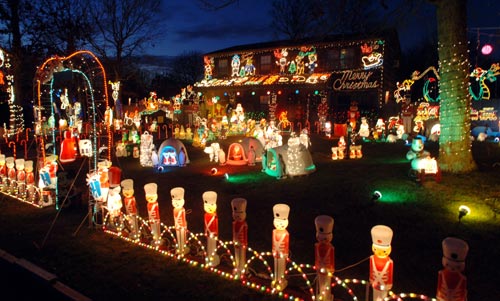
My time in the USA has provided me with plenty of opportunities to enjoy houses decorated for the Christmas season. These are lit-up for the entire month of December, often even until January 6, the traditional feast of the Epiphany and the end of the Christmas season. The New York houses were at times overcrowded with images and symbols, crammed into a limited front lawn, but the Bend, Oregon homes, having more property, the lights are more spread out, and are more visible, allowing the owners to be more creative.
Here you have the contrast between a Bend, Oregon house and a New York house. While the first photo is a digital photo, and so is much sharper than the second one taken with a conventional camera, and this is a scanned copy of a printed photo. Neighbors are usually very unhappy as hundreds of people gather to enjoy these houses, while they park their cars in the limited space available.
Monday, 18 December 2023
The Christmas Cactus
I’d like to introduce you today to a plant that usually flowers at this time of the year, thereby being called often the Christmas cactus. Scientifically, it is called Schlumbergera, a small species of cacti with six to nine species found in the coastal mountains of south-eastern Brazil. These plants grow on trees or rocks in habitats that are generally shady with high humidity, and can be quite different in appearance from their desert-dwelling cousins. Most species of Schlumbergera have stems which resemble leaf-like pads joined one to the other and flowers which appear from areoles at the joints and tips of the stems. In Brazil, the genus is referred to as Flor de Maio (May flower), reflecting the period in which they flower in the Southern Hemisphere. Most of the popular houseplants grow with flowers in white, pink, yellow, orange, red or purple. The plants are offered for sale under a variety of common names. The earliest English common name was "Christmas cactus". In Europe, where plants are largely produced for sale in the period before Christmas, this remains the most widely used common name in many languages (e.g. Weihnachtskaktus in German, cactus de Noël in French, and cacto de Navidad in Spanish). This is also the name used in Canada. In the United States, where plants are produced for the Thanksgiving holiday in November, the name "Thanksgiving cactus" is also used.
It was named after Frédéric Schlumberger, who had a collection of cacti at his chateau near Rouen. It was originally discovered in 1837 and named Epiphyllum russellianum. The plants need some light, cooler temperatures and occasional watering. Too much light causes stems to take on a reddish colouration; however, very low light levels will prevent flowering. Day length is important in controlling flowering; continuous darkness for at least 12 hours is necessary to induce bud formation. A period of about 8 days with 16 hours of darkness at 16 °C (61 °F) has been shown to cause flower buds to form.
Sunday, 17 December 2023
Happy Birthday Pope Francis
Happy Birthday Pope Francis. He turns 87 today. Born in Argentina as Jorge Bergoglio. Ordained a priest on December 13, 1969. Consecrated Bishop June 27, 1992. Created as Cardinal February 21, 2001. Elected Pope on March 13, 2013.
Just this week he announced that he would like to be buried at St. Mary Major’s basilica, close to his favorite image of Salus Populi Romani. Maria Salus Populi Romani (Saint Mary, Health of the Roman People) is an ancient icon measures five feet in height and three and a quarter feet in width (117 x 79 cm). It arrived from Crete in 590 AD during the Pontificate of Pope Gregory the Great and was placed in the Roman Basilica of Saint Mary Major.
He has visited this church over 100 times so far, every time he travels, before and after his trip. 6 other Popes are buried there, including Pope St. Pius V, the Dominican Pope who introduced the white cassock of a Pope, especially after a few hot summers 400 years ago, and since the Dominicans wear white, he felt it was a little bit cooler than the black cassock that priests use. Pope Francis hinted that he may be able to visit his homeland of Argentina sometime next year, besides a few other places he mentioned in various interviews. Ad Multos Annos Papa Francesco !
Saturday, 16 December 2023
Vatican Nativity
On the 800th anniversary of St Francis of Assisi setting up the first Nativity scene, the creche in St Peter’s Square in 2023 will come from the Diocese of Rieti, Italy, in paying tribute to the scene set up in the diocese in 1223. St Francis’ Nativity scene in a cave in Greccio featured live animals, but the one unveiled in St Peter’s Square on December 9 will not. But the scene still will be very simple: Mary and Joseph and the baby Jesus, some shepherds and figures representing the nobleman Giovanni Velita, his wife Alticama, and three Franciscan friars who, at St Francis’ behest, put a hay-filled manger, an ox and a donkey in a grotto where the local faithful could come to pray and to imagine the poverty and simplicity into which Jesus was born. The crib is accompanied by a 25-metre (80-foot) fir tree from the Piedmont region.
Friday, 15 December 2023
Nativities Exhibition – part 3
A few more nativities from the Exhibition being held at
the President’s Palace in Valletta. The first one is one of my favorites as it
shows a very intimate moment between Mary and her baby as she nurses him in her
humble home, probably somewhere in Egypt, as they spent 2 years as refugees,
escaping from Herod’s wrath. The next one is the Presentation at the temple, as
Simeon welcomes them and blesses the child Jesus after he is circumcised. A Nativity in a wintry setting gives us an insight into what it would have been like if Jesus was born in Sweden or Mongolia or Canada. The
last one is another modern setting of a nativity.
Thursday, 14 December 2023
Nativities Exhibition - part 2
Wednesday, 13 December 2023
Saint Lucy

We celebrate today the feast of Saint
Lucy, one of the early young martyrs of the Catholic church. Lucy's name
means "light", with the same root as "lucid" which means
"clear and radiant." Unfortunately for us, Lucy's history does not
match her name. Shrouded in the darkness of time, all we really know for
certain is that this brave woman who lived in Syracuse lost her
life in the persecution of Christians in the early fourth century.
Her veneration spread to Rome so that by the sixth century the whole
Church recognized her courage in defence of the faith. Her mother tried to
arrange a marriage for her with a pagan. Lucy however was determined that she would be married
only the Jesus, by remaining faithful to Him and her faith. Unfortunately, her bridegroom did not see the same light and he betrayed
Lucy to the governor as a Christian. This governor tried to send her into
prostitution but the guards who came to take her away found her stiff and heavy
as a mountain. Finally she was killed. Apparently she had beautiful eyes, and the
Emperor Diocletian demanded that her eyes will be gouged out. Lucy's name also played a large part in
naming Lucy as a patron saint of the blind and those with eye-trouble, cataract and glaucoma, and other vision
problems.
Tuesday, 12 December 2023
Our Lady of Guadalupe
The image of Our Lady of Guadalupe is one of the most treasured among Mexicans and Catholics alike. It all started in 1531 when an Aztec Indian named Juan Diego was walking through the Tepayac hill country in central Mexico. The Blessed Mother appeared tohim and requested that a church be built in that place. No one would believe him, not even the local Bishop Zumarraga, who requested a sign from Juan. On a successive visit, Juan was told to collect a full bloom of Castilian roses. Removing his coat or tilma, he cut the roses and Mary kindly rearranged them in his tilma. When he visited the Bishop, Juan told him what had transpired on the frozen hill, then he opened the tilma letting the flowers fall out. But it wasn't the beautiful roses that caused the bishop and his advisors to fall to their knees; for there, on the tilma, was a picture of the Blessed Virgin Mary precisely as Juan had described her to them. The tilma shows Mary as the God-bearer - she is pregnant with her Divine Son. Over the years, the miraculous tilma has been subject to a variety of environmental hazards including smoke from fires and candles, water from floods and torrential downpours. But it has survived. In 1977, the tilma was examined using infrared photography and digital enhancement techniques. Unlike any painting, the tilma shows no sketching or any sign of outline drawn to permit an artist to produce a painting. Further, the very method used to create the image is still unknown. It can be seen today in a large cathedral built to house up to ten thousand worshipers. It is, by far, the most popular religious pilgrimage site in the Western Hemisphere. Mexicans celebrate this apparition today with a morning prayer at 5 AM called Mañanitas, and an evening Mass followed by plentiful food during a fiesta, with dancing and drinking of Tequila with lime.
Monday, 11 December 2023
Nativities Exhibition – part 1
I visited yesterday an exceptional exhibition of Nativities and Presepios hosted at the President’s Palace in Valletta. Obviously I came back with over 100 photos and I share some of them during the coming few days. Most of them are by Italian and Maltese craftsmen who emphasize simplicity, originality, as well as a pastoral and domestic approach to the theme of the Birth of Christ. Some of the presentations did not present the customary stable of Bethlehem, but instead an event from the life of the Holy Family, as you will see in these three Nativities, with a description under each photo. (Please do click on each photo to enlarge it)
Sunday, 10 December 2023
Stay with us, dear Jesus
As we head John the Baptist's advice today to prepare for the coming of Jesus in our homes, heart, lives and parish communities, I share with you this reflection on how important it is for us to stay close to Jesus:
When we get lonely, You’re the perfect companion.
When we are afraid, You can surely encourage us.
When we fear the unknown future, You affirm our past and present.
When we experience weakness, You are there to strengthen us.
When we lose our way to You, Your spiritual compass is our one and only hope.
When we lose heart, You always comfort us an show us compassion.
When we don’t know what to say or how to pray, You always have the right suggestion.
When we cannot see clearly, You always help us focus our perspective of life.
When we want to hurt others and say that nasty word, You always correct our speech and manner of behavior.
When we act stubborn, You tolerate us.
When we act selfish, You show us a kind caring way to do things.
And when we falter as humans, You grant us Your mercy and Forgiveness. Not only that, but You forgive and forget.
Saturday, 9 December 2023
Botticelli discovered !
A painting by 15th century master Sandro Botticelli has been recovered at a home in Southern Italy. Believed to be worth €85 million, it was lost around 50 years ago, and since has been forgotten. Originally donated by the artist to Pope Sixtus IV, it was later housed in a church in the town of Santa Maria la Carità. Then, a local family was entrusted to keep it at their private residence for generations. After many thought it had been lost forever, the Carabinieri Command for the Protection of Cultural Heritage traced it to a property in Gragnano, near Naples. A depiction of Madonna and a child, the painting has deteriorated, with abrasions and chromatic alterations seen all over, and will now require major restoration. It will be entrusted to the care of an Institute of the Ministry of Culture specialised in the sector of restoration of works of art in order to start a study process and valorisation of the painting. Botticelli’s most famous works include ‘The Birth of Venus’ and ‘Primavera’, which are displayed in the Uffizi Gallery in Florence.
Friday, 8 December 2023
Immaculate Conception
Back in the 1980s, the church in Malta for some unexplained reason, eliminated a few holy days of obligation, including the feast we celebrate today, the Immaculate Conception of Mary. Still Mary is a dominant figure in our Catholic church, and just within a month, we have 4 major feasts in her honor. Besides today, we honor Our Lady of Guadalupe, the apparition to Juan Diego in 1531, we celebrate also the birth of Jesus and the feast of Mary, Mother of Jesus and all of us on January 1st. Today I also like to acknowledge two persons who are overlooked on this feast day, that is St. Anne and St Joachim, Mary’s parents. It was in 1854 that Pope Pius IX, after consulting with all the bishops of the world, pronounced and proclaimed the Dogma of the Immaculate Conception. This was a rare event and it took another 96 years to have another Dogma proclaimed, this time the Assumption of Mary in 1950. Then another event happened that affirmed the Immaculate Conception of Mary, only 4 years later, when in 1858, the apparition at Lourdes took place, Mary revealing herself to Bernadette Soubirous as the Immaculate Conception. The Encyclical Ineffabilis Deus that proclaimed the Dogma proclaims that the Blessed Virgin Mary, “in the first instance of her conception, by a singular privilege and grace granted by God, in view of the merits of Jesus Christ, the Savior of the human race, was preserved free from all stain of original sin, is a doctrine revealed by God and therefore to be believed firmly and constantly by all the faithful.”
Thursday, 7 December 2023
The Maltese festa
The festa has been recognised by UNESCO as part of Malta’s intangible cultural heritage which needs urgent safeguarding – granting stronger protection to its traditional elements. It joins the Għana (Maltese folk song) and the ftira (a typical loaf of bread) that were listed in 2021 and 2020 respectively. UNESCO recognised the value of all the elements of the festa: the liturgical and the traditional outdoor celebrations. Every year a UNESCO committee meets to evaluate nominations made by various countries and decides whether or not to inscribe cultural practices and expressions of intangible heritage on the list. This year the festa was accepted during a meeting in Botswana. The 2023 list included traditional Syrian glassblowing, the Alpine pasture season in Switzerland and the Bolero as an indispensable part of the Latin American sentimental song. The festa is a community event of religious origin held annually in village parishes across Malta and Gozo. The main festa season in Malta starts towards the end of April and runs until the beginning of October, with multiple events taking place in different villages. Community volunteers prepare the festa throughout the year and the event itself typically lasts a week. On the final day, a statue is carried in a procession led by the clergy and accompanied by members of the parish and marching bands. Festa weeks entail concerts, band marches, firework displays and bell ringing.
Typical festa food, such as nougat, is sold from street stalls. Youth
learn the stories and songs of the village and its sacred figures and how to
participate in the festa by attending community events. Some parishes organise a
children’s festa in conjunction with the church, and children carry a
smaller statue through the town. Despite its increased secularisation, the festa remains an important part of cultural heritage in Maltese
villages, uniting families, outsiders and local communities in a celebration of
popular religiosity and local identities.
Wednesday, 6 December 2023
Saint Nicholas
St. Nicholas was born during the third century in the village of Patara. At the time the area was Greek and is now on the southern coast of Turkey. His wealthy parents, who raised him to be a devout Christian, died in an epidemic while Nicholas was still young. Obeying Jesus' words to "sell what you own and give the money to the poor," Nicholas used his whole inheritance to assist the needy, the sick, and the suffering. He dedicated his life to serving God and was made Bishop of Myra while still a young man, and became known throughout the land for his generosity to those in need, his love for children, and his concern for sailors. Perhaps the best-known story about Nicholas concerns his charity toward a poor man who was unable to provide dowries for his three daughters of marriageable age. Rather than see them forced into prostitution, Nicholas secretly tossed a bag of gold through the poor man’s window on three separate occasions, thus enabling the daughters to be married. Over the centuries, this particular legend evolved into the custom of gift-giving on the saint’s feast. And so in the English-speaking countries, St. Nicholas became, by a twist of the tongue, Santa Claus. Under the ruthless Emperor Diocletian, Bishop Nicholas suffered for his faith, was exiled and imprisoned. The prisons were so full of bishops, priests, and deacons, there was no room for murderers, thieves and robbers. After his release, Nicholas attended the Council of Nicea in 325 AD. He died December 6, 343 in Myra and was buried in his Cathedral church. In the spring of 1087, sailors from Bari, afraid of the Muslim invasion, succeeded in spiriting away the relics from that Cathedral, bringing them to Bari, a seaport on the southeast coast of Italy. An impressive church was built over St. Nicholas' crypt and many faithful journeyed to honor the saint who had rescued children, prisoners, sailors, famine victims, and many others through his compassion, generosity, and the countless miracles. To this day pilgrims and tourists visit Bari's great Basilica di San Nicola. Both the Eastern and Western Churches honor him, and it is claimed that, after the Blessed Virgin, he is the saint most pictured by Christian artists.