Thursday, 5 October 2017

Saint Faustina Kowalska

St. Faustina Kowalska (1905-1938)
Saint Faustina was born Helena Kowalska in a small village west of Lodz, Poland on August 25, 1905. She was the third of ten children. When she was almost twenty, she entered the Congregation of the Sisters of Our Lady of Mercy, whose members devote themselves to the care and education of troubled young women. The following year she received her religious habit and was given the name Sister Maria Faustina, to which she added, "of the Most Blessed Sacrament", as was permitted by her congregation's custom. In the 1930's, Sister Faustina received from the Lord a message of mercy that she was told to spread throughout the world. She was asked to become the apostle and secretary of God's mercy, a model of how to be merciful to others.
Her entire life, in imitation of Christ's, was to be a sacrifice ‑ a life lived for others. At the Divine Lord's request, she willingly offered her personal sufferings in union with Him to atone for the sins of others; in her daily life she was to become a doer of mercy, bringing joy and peace to others, and by writing about God's mercy, she was to encourage others to trust in Him and thus prepare the world for His coming again. Her special devotion to Mary Immaculate and to the sacraments of Eucharist and Reconciliation gave her the strength to bear all her sufferings as an offering to God on behalf of the Church and those in special need, especially great sinners and the dying.
She wrote and suffered in secret, with only her spiritual director and some of her superiors aware that anything special was taking place in her life. After her death from tuberculosis in 1938, even her closest associates were amazed as they began to discover what great sufferings and deep mystical experiences had been given to this Sister of theirs, who had always been so cheerful and humble. She had taken deeply into her heart, God's gospel command to "be merciful even as your heavenly Father is merciful" as well as her confessor's directive that she should act in such a way that everyone who came in contact with her would go away joyful. For many years her diary was condemned, and even the image of Jesus as she portrayed was abolished. However everything changed when Pope John Paul II was elected Pope. Her case was re-opened and by the year 2000, the Divine Mercy Sunday was established and to be celebrated the Sunday after Easter. On the same day in the year 2000, St Faustina was declared a Saint. The message of mercy that Sister Faustina received is now being spread throughout the world; her diary, Divine Mercy in my Soul, has become the handbook for devotion to the Divine Mercy. 

Wednesday, 4 October 2017

St Francis of Assisi

Probably one of the most beloved and well‑known Saints, even among non‑Catholics, St Francis became affectionately known as the patron saint of animals. And in his honor, we bless our dogs, our cats, our lizards, horses and noisy cockatiels every year. He became one of the Church's most efficient reformers and started by reforming himself. The son of a cloth‑merchant, one day he stripped naked in the local piazza and gave his father Bernardone everything he had, including the clothes he was wearing. Instead he put on him a simple robe and gathered around him a few other men (among them St Anthony) and thus started the Franciscan order.
The catalyst for this move came after a vision he had at the church of San Damiano, when Jesus spoke to him through the famous colorful cross and asked him to go and rebuild his church. This meant literally and figuratively, because he did fix the dilapidated church, but also founded an order which is still going very strong around the world, 800 years after its foundation.
Later in his life, St Francis received the stigmata, the wounds of Christ and also inspired St Clare to start the female counterpart of the Franciscan Order, the Poor Clares. He was also known to have created the first nativity during the Christmas midnight Mass, taking the image of the baby Jesus down to the crypt, where he had already placed a donkey and cow and a manger with straw.
To many of us, St Francis may seem out of touch with reality, rather than a profound philosopher. But that's exactly the kind of people the church needs even today, down‑to‑earth workers, with a good scale of values and who know where their priorities are. Francis lived a short life, born in 1181 and dying in 1226, but in his short life, he started a revolution of love, compassion, charitable work and encouraged everyone for a life of poverty, a lifestyle that all the Franciscans around the word still imitate.

Tuesday, 3 October 2017

I Love Las Vegas

I’ve never been to Las Vegas, but once I did cross the border between Oregon and Nevada. It was beautiful country in Northern Nevada, and the only peculiar thing I remember is seeing a bunch of wild donkeys crossing the road in front of me, just as cows do so frequently in Oregon. Another cute story I heard about Las Vegas is about the Cathedral, dedicated to the Guardian Angel. When people attend church there on weekends, many of them, instead of putting money in the collection, they throw chips from their Casinos. Then on Monday morning, a monk goes around the Casinos and exchanges the chips for money.....and yes, they call him the chip-monk. It’s true.
But today my heart goes out to the Nevada people and possibly many from California and Arizona who last Sunday were happily gathered to attend a Country and Western concert, all in their cowboy boots and cowboy hats, enjoying an evening with friends. Then within a few minutes their lives were shattered by a senseless act of terror precipitated by a solitary gunman. Close to 60 people are dead so far and over 500 injured with gun-shot wounds. Countless families and individuals destroyed, others have their lives turned upside down, and may young holiday-makers, tourists and visitors see their lives go up in flames. Parents losing their children, children ending up orphans, and loved ones separated for ever by a cruel act of horrible evil.
My major recollection of driving through Nevada.
Let us pray for the victims, for the injured, for the survivors and those who helped the injured, for their families and friends. Let us pray for the people of Las Vegas, who now add their city to a list of towns and villages known and remembered for terrible tragedies, Colombine in Colorado, Sandy Hook in Connecticut, Orlando in Florida, San Bernardino in California, Aurora in Colorado, Virginia Tech in Virginia, Killeen in Texas, and others. May the Guardian Angel of each victim walk with them into their new heavenly home, precisely as they leave this earth in the feast of the Guardian Angel.

Monday, 2 October 2017

Guardian Angels

Todays feast of the Guardian Angels reminds us of the protection we always received from our Angels, who were assigned to us when we were born. Ive always been aware of the presence of my Guardian Angel, whom I named Stephen, and on many occasions, I knew he was with me, no doubt about it. A 1962 Apostolic Exhortation by Pope St. John XXIII says that Guardian Angels can help us at a physical level, lifting us up, keeping at bay some dangerous animal or thing, drawing our attention to danger by means of a noise. Similarly they can intervene on a psychic level too. George Huber wrote a book entitled My Angel will go before you, and in it he recalls two stories of Popes who depended on their Guardian Angels. Pope Pius XI denounced Stalin, confronted Hitler and resisted Mussolini, but he said he always relied on his Guardian Angel right through the entire day. He even told one of his apostolic delegates, Monsignor Angelo Roncalli, the future Pope John XXIII that whenever they have to be persuasive in their arguments against someone who appears adamant, we let our Guardian Angels take it up with their own Angels, and once they establish an understanding, the Popes conversation becomes much easier.  St. John XXIII in a private conversation with a Canadian Bishop, attributed the idea of calling an ecumenical council to his Guardian Angel - it was through his Angel that God gave him the inspiration to convoke Vatican Council II, 58 years ago.
What my Guardian Angel Stephen looks like.
St Bernard on the Angels
He has given his angels charge over you to guard you in all your ways. "These words should fill you with respect, inspire devotion and instill confidence; respect for the presence of angels, devotion because of their loving service, and confidence because of their protection. And so the angels are here; they are at your side, they are with you, present on your behalf. They are here to protect you and to serve you. But even if it is God who has given them this charge, we must nonetheless be grateful to them for the great love with which they obey and come to help us in our great need.
So let us be devoted and grateful to such great protectors; let us return their love and honor them as much as we can and should. We should then, my brothers and sisters, show our affection for the angels, for one day they will be our co-heirs just as here below they are our guardians and trustees appointed and set over us by the Father. Even though we are children and have a long, a very long and dangerous way to go, with such protectors what have we to fear? They who keep us in all our ways cannot be overpowered or led astray, much less lead us astray. They are loyal, prudent, powerful. Why then are we afraid? We have only to follow them, stay close to them."

Sunday, 1 October 2017

St Therese of Lisieux

Real photo of St Therese, the 'Little Flower' (1873-1897)
Generations of Catholics have admired this young saint, called her the "Little Flower", and found in her short life more inspiration for their own lives than in volumes by theologians.
Yet Therese died when she was 24, after having lived as cloistered Carmelite for less than ten years. She never went on missions, never founded a religious order, never performed great works. The only book of hers, published after her death, was a brief edited version of her journal called "Story of a Soul." But within 28 years of her death, the public demand was so great that she was canonized.
Therese was born in France in 1873, the pampered daughter of a mother who had wanted to be a saint and a father who had wanted to be monk. The two had gotten married but determined they would be celibate until a priest told them that was not how God wanted a marriage to work! They must have followed his advice very well because they had nine children. The five children who lived were all daughters.
Tragedy and loss came quickly to Therese when her mother died of breast cancer when she was four and a half years old. Her sixteen year old sister Pauline became her second mother ‑‑ which made the second loss even worse when Pauline entered the Carmelite convent five years later. Therese’s parents were eventually beatified in October 2008 and canonized in October 2015.
When her other sisters, Marie and Leonie, left to join religious orders (the Carmelites and Poor Clares, respectively), Therese was left alone with her last sister Celine and her father. She wanted to enter the Carmelite convent to join Pauline and Marie but how could she convince others that she could handle the rigors of Carmelite life. When the superior of the Carmelite convent refused to take Therese because she was so young, the formerly shy little girl went to the bishop. When the bishop also said no, she decided to go over his head.
Another authentic photo of St Therese
Her father and sister took her on a pilgrimage to Rome to try to get her mind off this crazy idea. Therese loved it. It was the one time when being little worked to her advantage! Because she was young and small she could run everywhere, touch relics and tombs without being yelled at. Finally they went for an audience with the Pope. They had been forbidden to speak to him but that didn't stop Therese. As soon as she got near him, she begged that he let her enter the Carmelite convent. She had to be carried out by two of the guards!
But the Vicar General who had seen her courage was impressed and soon Therese was admitted to the Carmelite convent that her sisters Pauline and Marie had already joined.
Her romantic ideas of convent life and suffering soon met up with reality in a way she had never expected. Her father suffered a series of strokes that left him affected not only physically but mentally. As a cloistered nun she couldn't even visit her father before he died.
She knew as a Carmelite nun she would never be able to perform great deeds. Therese took every chance to sacrifice, no matter how small it would seem. She smiled at the sisters she didn't like. She ate everything she was given without complaining ‑‑ often given the worst leftovers.
When Pauline was elected prioress, she asked Therese for the ultimate sacrifice. Because of politics in the convent, many of the sisters feared that the family Martin would take over the convent. Therefore Pauline asked Therese to remain a novice, in order to allay the fears of the others that the three sisters would push everyone else around. This meant she would never be a fully professed nun. Upon their father’s death, now Celine also entered the convent. Four of the sisters were now together again. In this small convent they now made up one‑fifth of the population. Despite this and the fact that Therese was a permanent novice they put her in charge of the other novices.
Then in 1896, she coughed up blood. She kept working without telling anyone until she became so sick a year later everyone knew it. She died on September 30, 1897 at the age of 24 years old. After she died, Pauline put together Therese's memoirs and sent 2000 copies to other convents. Within two years, the Martin family had to move because her notoriety was so great and by 1925 she had been canonized. 

Saturday, 30 September 2017

What one person can do

My child, I’ve often heard your question. Now this message is my answer.
You’re concerned about the hungry in the world, millions who are starving....and you ask “What can I do?”  - Feed One!
You grieve for all the unborn children murdered every day....and you ask “What can I do?”  - Save one!
You’re haunted by the homeless poor who wander city streets,.....and you ask “What can I do?”  - Shelter one!
You feel compassion for those who suffer pain, sorrow and despair,....and you ask “What can I do?” – Comfort one!
Your heart goes out to the lonely, the abused and the imprisoned,.....and you ask “What can I do?”  - Love one!

Remember this my child....two thousand years ago the world was filled with those in need, just as it is today, and when the helpless and the hopeless called out to me for mercy, I sent a Savior. Hope began with only one!

Friday, 29 September 2017

The Archangels

'The Three Archangels' by Filippino Lippi
Today is the feast of the Archangels, Michael, Gabriel and Raphael. Michael ‑ the angel of Judgment ‑ is known as the champion in the fight against Satan and the other devils as well as the guardian of the faithful especially at the time of death. Frequently he is portrayed crushing the devil’s head with a lance. Gabriel ‑ the angel of Mercy ‑ is the messenger from God in St Luke’s gospel who foretold the birth of John the Baptist, “Be not afraid, Zechariah, because your prayer has been heard. Your wife, Elizabeth, will bear you a son, and you shall name him John.” Six months later it was Gabriel who appeared to Mary at the Annunciation saying, “Do not be afraid, Mary, for you have found favor with God. Behold, you will conceive in your womb and bear a son, and you shall name him Jesus.” Raphael ‑ the angel of Healing - was sent by God to heal Tobias of his blindness and to deliver Sara from the devil in the book of Tobit.
We tend to underestimate the presence of Angels in our lives. However they are gaining popularity as we see many angel pins on people’s jackets, posters and paintings of various angels are showing up at card stores. And of course at Christmas, there are the angels on ornaments and hanging on nativity scenes. We sing about the angels in several of the Christmas carols. Angels were also present at Jesus’ tomb when the women went to anoint his body and found the tomb empty. But we are reluctant to accept their actual existence. This is certainly a departure from our childhood when we prayed to our Guardian Angel at least daily. As children we believed that there was truly one angel whose job was to look after us, who would always hover around us ready to protect us from all evil and to communicate our desires and needs to God. The feast of the Guardian Angels is in 3 days, on October 2. There are other inferior angels whose names also have interesting meanings: Uriel – the Fire of God; Selaphiel – Intercessor of God; Jegudiel – Glorifier of God; Barachiel – Blessing of God, and Jeremiel – the Exaltation of God.

Thursday, 28 September 2017

An Appeal

I pray on my knees today in my chapel, asking for help. It’s a simple appeal to get more visitors to this blog. I’ve heard many people recently and over the years telling me how much they enjoy visiting my blog every day. I hope they keep checking it daily, as I place a post every day, ever since 2012 when I started blogging. There were a handful of days when I did not have access to the Internet and I could not post anything. But as you all know, I’ve been faithful to my mission of sharing some food for thought every day.
My appeal is very simple. May I ask each visitor to share this blog with at least one other person on your mailing list, or a dear friend, whom you think would appreciate this blog. And whenever someone writes to you in a surprising, unexpected way, let them know about the blog. There is always something inspirational which may surprise you. It could be a simple quote, a prayer, reflection, anecdote, life of a saint, interesting story, or one of the many photos with a message.
I appreciate your effort in this, and I will let you know in a few weeks if I find an increase in the visits. Presently I am getting an average of 100 visits daily. My hope is that we can double that number. Just this past week, I got these visitors from these countries: USA – 297, Malta – 172, Armenia – 25, Spain – 10, Germany – 7, Portugal – 7, Brazil – 6, Ukraine – 5, Philippines – 4 and Pakistan – 4. Plus many others.
I personally do not use Facebook, but when someone shares the address of my blog through Facebook, the number of visitors at least triples itself. So anyway you can share the address will be helpful. Let them know that scrolling down on the right hand side, you can click on Older Posts, and feast yourself with much more food for thought. My old blog from the USA is still active, and there are over 1500 posts there to feast on at this address:   www.fatherjulian.blogspot.com

This blog already has 520 posts, and counting. I thank you for visiting, for sharing and for appreciating Dun Giljan's blog.

Wednesday, 27 September 2017

Oman galley leaves Malta

Galley from Oman leaving Grand Harbor in Valletta, Malta.
Continuing on the exit of the galley from the Grand Harbor of Malta, I can tell you that the flag belonged to the state of Oman, a country in the Middle East, with its capital city being Muscat. As the sun rose over the harbor, the galley sailed away, precisely at 8 AM, as was advertised beforehand. I thought for sure that it would leave later, but sure enough the Omanis seem to be extremely punctual. I waited to see if the sails would open, especially with all those sailors hanging precariously on the beams, but it was not meant to be. However the last photo shows what it would have looked like with its full regalia and splendor.
Passing through the breakwater and into the open Mediterranean Sea.
Sailors show the flag of Malta on the left, and the flag of Oman on the right.
The Oman galley sailing through the open seas.

Tuesday, 26 September 2017

Galley leaving Malta

Massive galley leaving Malta's Grand Harbor. No shots were fired!
Yesterday I left home very early to capture the departure of a beautiful galley that was anchored for a few days in the main harbor of Valletta. Obviously my intention was to take a few photos of this galley, hopefully with its sails open. Even though I was disappointed as the sails never came down, I still got some good photos which I will share over two days as they capture the whole process of leaving a harbor with the sailors positioned to open the sails. They were hanging on the horizontal beams of the galley, ready to unfurl the sails, which they probably did as soon as they got into the wind outside the harbor. 
Sailors precariously positioned on the beams ready to unfurl the sails.
One of the photos show the sailors with two flags, one of which was the flag of Malta, half red and half white with the George Cross on the top corner on the white part. I was curious to find out to which country the other flag belonged to, and after a little research I did, but I’ll keep you guessing until tomorrow, to see if anyone is able to find out and reveal the mystery country.
Galley passing by one of the fortifications built by the Knights of Malta
Sailors waving to the people of Malta

Monday, 25 September 2017

Serenity Prayer

The Prayer made from US license plates
This popular prayer was written by Reinhold Niebuhr. The earliest recorded reference to the prayer is a diary entry from 1932 by Winnifred Crane Wygal, a pupil and collaborator of Reinhold Niebuhr, the American theologian who lived between 1892 and 1971. The prayer spread both through Niebuhr's sermons and church groups in the 1930s and 1940s and was later adopted and popularized by the Alcoholics  Anonymous. The AA members adopted this prayer as they follow the twelve step program. Many members use the prayer as a tattoo on their bodies.
God, give me grace to accept with serenity the things that cannot be changed, Courage to change the things which should be changed, and the Wisdom to distinguish the one from the other.
Living one day at a time, enjoying one moment at a time, accepting hardship as a pathway to peace,
Taking, as Jesus did, this sinful world as it is, not as I would have it, trusting that You will make all things right, if I surrender to Your will, so that I may be reasonably happy in this life, and supremely happy with You forever in the next. Amen.

Sunday, 24 September 2017

What is Life?

Sunset in Malta on September 20, 2017
Life is an opportunity.........................don’t lose it.
Life is beautiful...................................admire it.
Life is peaceful....................................appreciate it.
Life is a dream....................................make it a reality.
Life is a challenge...............................accept it.
Life is a responsibility........................accomplish it.
Life is a game......................................play your part.
Life is precious....................................protect it.
Life is a treasure.................................guard it well.
Life is an experience of love...............share it with others.
Life is a mystery.................................discover it.
Life is a promise.................................realize it.
Life is a form of suffering...................overcome it with courage.
Life is a melodious song.....................sing it.
Life is a fight.......................................join the battle.
Life is a tragedy..................................overcome it.
Life is an adventure............................go along the journey.
Life is a lot of fun................................earn the right to deserve it.
Life is a faith experience....................give the example daily.
Life is a lesson....................................learn it quickly and early.
Life is a hill.........................................climb it slowly.
Life is a struggle.................................conquer it boldly.
Life is an objective.............................realize it.
Life is a way........................................walk it gently.
Life is a competition...........................join the race.
Life is life itself...................................defend it.

Saturday, 23 September 2017

St Pio of Pietralcina

St Pio of Pietralcina (1887-1968)
Pope St. John Paul II canonized Padre Pio of Pietralcina on June 16, 2002. It was the 45th canonization ceremony in Pope John Paul's pontificate. More than 300,000 people braved blistering heat as they filled St. Peter's Square and nearby streets. They heard the Holy Father praise the new saint for his prayer and charity. Many people have turned to the Italian Capuchin Franciscan to intercede with God on their behalf; among them was the future Pope John Paul II. In 1962, when he was still an archbishop in Poland, he wrote to Padre Pio and asked him to pray for a Polish woman with throat cancer. Within two weeks, she had been cured of her life‑threatening disease.
Born Francesco Forgione in 1887, Padre Pio grew up in a family of farmers in southern Italy. Twice (1898‑1903 and 1910‑17) his father worked in Jamaica, New York, to provide the family income. At the age of 15, Francesco joined the Capuchins and took the name of Pio. He was ordained in 1910 and was drafted during World War I. After he was discovered to have tuberculosis, he was discharged. In 1917 he was assigned to the friary in San Giovanni Rotondo. On September 20, 1918, as he was making his thanksgiving after Mass, Padre Pio had a vision of Jesus. When the vision ended, he had the stigmata in his hands, feet and side.
Life became more complicated after that. Medical doctors, Church authorities and curiosity seekers came to see Padre Pio. In 1924 and again in 1931, the authenticity of the stigmata was questioned; Padre Pio was not permitted to celebrate Mass publicly or to hear confessions. He did not complain of these decisions, which were soon reversed. However, he wrote no letters after 1924. His only other writing, a pamphlet on the agony of Jesus, was done before 1924.
Padre Pio hearing confessions
Padre Pio rarely left the friary after he received the stigmata, but busloads of people soon began coming to see him. Each morning after a 5 a.m. Mass in a crowded church, he heard confessions until noon. He took a mid‑morning break to bless the sick and all who came to see him. Every afternoon he also heard confessions. In time his confessional ministry would take 10 hours a day; penitents had to take a number so that the situation could be handled. Many of them have said that Padre Pio knew details of their lives that they had never mentioned.
Padre Pio saw Jesus in all the sick and suffering. A fine hospital was built on nearby Mount Gargano in the 1940s, known as "House for the Alleviation of Suffering" and has 350 beds. A number of people have reported cures they believe were received through the intercession of Padre Pio. He died on September 23, 1968, and his stigmata disappeared as soon as he died. He was beatified in 1999 and made a saint in 2002.

Friday, 22 September 2017

A Garden of Happiness

First start by planting 4 rows of peas: Prayers, Politeness, Promptness, Purity.

Next plant 3 rows of squash:
Squash malicious gossip,
Squash destructive criticism,
Squash indifference and laziness.

Then proceed to plant 4 rows of lettuce.
Let us be faithful to our duties.
Let us be unselfish.
Let us be truthful to the Word of God.
Let us follow Christ closely.

Finally, no garden is complete without 5 rows of turnips.
So, turn up for church, punctually.
Turn up with a smile and a positive outlook.
Turn up with new ideas.
Turn up to volunteer and help out whenever needed. 
Turn up with determination for something good and worthwhile.

Thursday, 21 September 2017

Independence Day in Malta

Prime Minister George Borg Olivier showing the documents on Independence.
Malta was ruled over the past 2 millennia by the Carthaginians, Phoenicians, Romans, the Arabs, the Normans, the Spanish, the Knights of St John, the French and the British. Following a Maltese constitutional referendum in 1964, approved by 54.5% of voters, on September 21st 1964, Malta became an independent state as a Constitutional Monarchy, with Queen Elizabeth II as its Head of State.
So September 21st every year is celebrated as Independence Day or Jum l‑Indipendenza in Maltese, this year being the 53rd anniversary. One can say that both Labor Leader Dom Mintoff, as well as Nationalist Leader and Prime Minister George Borg Olivier contributed towards the attainment of Independence.
Front page of a special edition of the Times of Malta, September 21, 1964.
On December 1st 1964, Malta was admitted to the United Nations. In 1965 Malta joined the Council of Europe, and in 1970, Malta signed an Association Treaty with the European Community. Malta was declared a republic on December 13th, 1974 and in 2004, Malta finally became the 25th nation to join the European Union. I was only 12 years old when Malta became Independent, but I remember very well the week-long celebrations, one of which was for all the children.

Wednesday, 20 September 2017

New York City in the 1910s

5th Avenue in New York City in 1913
Continuing from yesterday's review of photos of New York City 100 years ago, here are three more vintage photos from that era. Incredibly enough, many of the buildings are still standing and in a very good condition. Many of the buildings were constructed by Italian immigrants and built between 1850 and 1900. So what you see in these photos are pretty much new buildings. And what you see in high risers is replicated underneath with a complicated Subway system, underground tunnels, electrical connections, pipes and sewage systems, all of which cater for the millions of people who live and work in the 'city that never sleeps.' (as usual click on each photo to enlarge)
The business district on Wall Street in New York City in 1911
Another section of 5th Avenue in New York City in 1913

Tuesday, 19 September 2017

NYC over 100 years ago


New York City - 42nd Street in 1910
With the United Nations convening this week in New York City, and all the eyes of the world focus on this big city and reflect on the many speeches to be delivered there this week by leaders of nations, I want to take you back to over 100 years ago and see what New York City looked like back then. Three more photos will be on my post tomorrow, and so, here are 4 images of the city that never sleeps. 
New York City Public Library in 1915
Observe the cars and clothing of the people, with most many wearing top hats. Most building shown are still standing today, and well preserved.
A fire in New York City in 1915
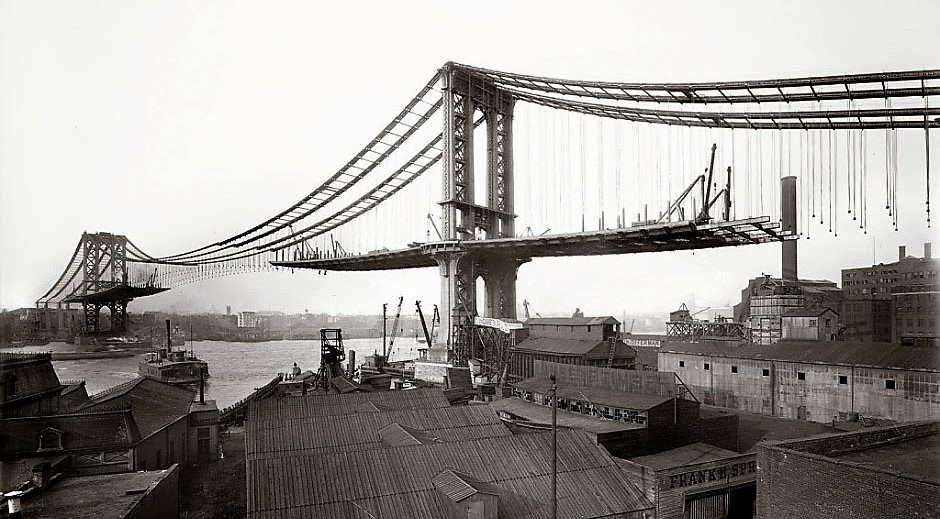
Manhattan Bridge being built in New York City in 1909

Monday, 18 September 2017

Characters and Temperaments

Pope John Paul I reigned only for 33 days in 1978, but as Albino Luciani, he became known for his love of the church, people and also history. He wrote a book called Illustrissimi, which means ‘Illustrious People,’ a collection of letters he wrote to fictional characters. In one of the letters, he is writing to Hippocrates, the father of Medicine, and in one section, he is describing different characters of different nationalities. I share with you this hilarious situation, which I’m sure is very real.
Well, the best place to discover people’s temperaments and characters is in a cheap restaurant. Or, to be exact, in a cheap restaurant where a thirsty man who has ordered a glass of beer has it brought to him with a big fly struggling in it. Is the customer an Englishman? Phlegmatically he places it on the table, calmly rings the bell and orders “Another glass of beer, cool and clean, please.” Having drunk it, he pays and goes out, neither moved nor upset. If anyone is upset, it is the waiter, not because of the fly, but because of the tip he didn’t get.
Is the glass of beer served to a Frenchman? He sees the fly and goes berserk. He slams down the glass, swears and shouts at the owner and the waiters, goes out slamming the door, and in the street carries on ranting and ranting against the beer, the fly and the restaurant.
An Italian comes in, looks at the fly, and smilingly flicks his middle finger at it to chase it off the surface of the beer. He jokes with the waiter: “Look, I asked you for a drink, and you’ve brought me something to eat,” but he drinks it all the same, and leaves, forgetting to pay the bill.
Now it’s the turn of the German: he sees the fly, keeps the glass raised to the height of his nose and frowns, shuts his eyes, puts back his head a little, and being highly disciplined, sends both beer and fly in a single gulp.
A Dane comes in. He is much amused to see the fly in the foam of the beer and takes out his glasses. So wholly taken up is he with the sight of the fly, that he would forget to drink if the waiter, having noticed the fly, didn’t change the first glass of beer with a second, with effusive apologies.
Last of all is the Eskimo. He’s never seen a fly and thinks that the one before him is a favorite local dish, a specialty. So he eats the fly and the throws the beer away!

Sunday, 17 September 2017

The Important and Unimportant

God, our Father, forgive us that we so often give our best to the wrong things.
Sometimes we put far more enthusiasm and thought and effort into our pleasures and our games and our amusement than we do into our work.

Sometimes we keep our best behavior for strangers and our worst behavior for our own homes; and often we treat our nearest and dearest with a discourtesy and disregard we would never show to strangers.
Sometimes we get irritated and annoyed and angry about things which in our calmer moments we know do not matter.
Sometimes we lose our temper in an argument about trifles.

Sometimes we allow very little things to cause a quarrel with a friend.
Help us to see what is important and what is unimportant, so that we may never forget the things that matter, and so that we may never allow the things which do not matter to matter too much.

Saturday, 16 September 2017

Words of Wisdom

We’ve all heard recommendations from parents, teachers, other leaders. Here are some priceless gems that you may have ignored in the past, but are worth remembering from now on.

  1. No one will ever get out of this world alive. Resolve therefore to maintain a reasonable sense of values.
  2. Take care of yourself. Good health is everyone’s major source of wealth. Without it, happiness is almost impossible.
  3. Resolve to be cheerful and helpful. People will repay you in kind.
  4. Avoid angry, abusive persons. They are generally vengeful.
  5. Avoid zealots. They are generally humorless.
  6. Resolve to listen more and to talk less. No one ever learns anything by talking.
  7. Be cautious in giving advice. Wise men don’t need it, and fools won’t heed it.
  8. Resolve to be tender with the young, compassionate with the aged, sympathetic with the striving, and tolerant of the weak and the wrong. Sometime in life you will have been all of these.
  9. Do not equate money with success. There are many successful money-makers who are miserable failures as human beings. What counts most about success is how a person achieves it.