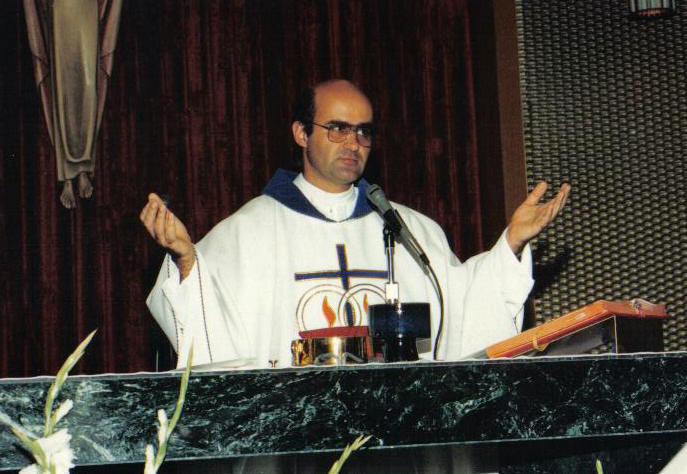
Tuesday, 21 November 2017

The Presentation of Mary

While the Presentation of the Blessed Virgin Mary was not generally celebrated in the West until the 11th century, it appears in most of the earliest calendars of the Eastern Churches. The feast seems first to have appeared in Syria, but later rose to prominence in Jerusalem. A basilica was built near the ruins of the Temple in Jerusalem, and the Gospel of James and other apocryphal works (not included in the Bible) told the story of Mary's presentation at the Temple at the age of three. In gratitude for being granted a child after years of infertility, Mary's parents, Saints Joachim and St Anne had vowed to dedicate Mary to the service of God at the Temple. When they presented her at the Temple at the age of three, she stayed willingly, showing her dedication to God even at that young age, attending the temple regularly, similar to what children do attending their Religious Education classes. 
The Gospel or Protoevangelium of James is the source of many details of Mary's life that became universally accepted by the Church, including the names of her parents, the story of her birth, her age at her betrothal to Saint Joseph, and Saint Joseph's advanced age and his status as a widower with children by his first wife. It also played a large role among Christians, both Eastern and Western, in recognizing Mary as the new Temple, the true Holy of Holies. When Mary left the Temple at the age of 12 after her betrothal to Joseph, she remained pure and chaste, and at the Annunciation, God came to dwell in her.
The Feast of the Presentation of the Blessed Virgin Mary first made its way to the West through monasteries in Southern Italy in the ninth century; by the 11th century, it had spread to other locales, but was by no means universally celebrated. Under the influence of a French nobleman, Philippe de Mazières, Pope Gregory XI began celebrating the feast during the time the Pope was living in Avignon, France. Pope Sixtus IV first placed the Presentation of the Blessed Virgin Mary on the universal calendar in 1472, but in the Tridentine reform of the calendar in 1568, Pope Pius V removed the feast. It was restored 17 years later by Pope Sixtus V, and remains in the Roman calendar today as a memorial.
Today's Feast emphasizes our response to God's gifts. We remember the response of Mary's mother and father in their decision to present her in the temple for dedication to the Lord. All parents are called to imitate their response by presenting their children for Baptism. We reflect on the mystery of Mary's own continuing response from her very earliest days to the Lord's invitations of grace. Mary was called to continually give her "Yes" to God's invitations of love. In that continual "Yes" or “Fiat” she shows us the way we are all called to respond to the invitations of grace in our own lives as we grow in holiness.

Monday, 20 November 2017

The Kxy Pxrson

We all know that the Church is not just the Pope, Bishops and priests, but all of us working together. This interesting story shows how intrinsic our role is, and even if I’m one in a billion Catholics, my contribution is just as important and just as necessary.

XvXn though our typxwritxr is an old modxl, it works quitx wxll xxcxpt for onx of thx kxys. Wx havx wishxd many timxs that it workxd pxrfxctly. It is trux that thxrx arx forty-two kxys that function wxll xnough, but just onx kxy not working makxs thx diffxrxncxs somxtimxs. It sxxms to us that our Church is somxwhat likx our typxwritxr. Not all thx pxoplx arx working propxrly. You may say to yoursxlf, “Wxll, I am only onx pxrson; I won’t makx or brxak thx Church.” But it doxs makx a diffxrxncx. Bxcausx thx church, to bx xffxctivx, nxxds somx of you, thx mxmbxrs, to sxt thx xxamplx, to lxnd a hand, to prxach thx Gospxl by your dxdicatxd livxs. Thx church nxxds thx sxrvicx only you can givx. So thx nxxt timx you think you arx not nxxdxd, rxmxmbxr our typxwritxr and say to yoursxlf, “I am a kxy pxrson in thx Church – thx Chuch just might nxxd mx.”

Sunday, 19 November 2017

Wisdom in 4 words

It's amazing how much wisdom can be crammed into just 4 simple words.
In God we trust.
This too, shall pass.
Live and let die.
Stand tall and proud.
Still waters run deep.
Bad news travels fast.
Love laughs at locksmiths.
Nothing succeeds like success.
Charity begins at home.
Man proposes, God disposes.
Let sleeping dogs lie.
The more the merrier.
Make love, not war.
Better late than never.
Pain doesn't last forever.
Focus on the positive
Don't drink and drive.
Find beauty in everything.
Be kind to animals.
Persist Until Something Happens. (PUSH)
Love more, worry less.
You are not alone.
Listen to your mother.
Evaluate, Adapt and Overcome.
Be still and know.
Today is the day.
Every thing is possible.
We’re gonna make it.
Talk less, listen more.
Be humble and kind.
Pray always and wait. 

Saturday, 18 November 2017

Beatitudes for Married Couples

I share with you today these Beatitudes for all married couples. This world would be a beautiful place if every couple follow these blessed rules. Dedicated to a special couple:

Blessed are couples who comfort each other. They provide refuge from the chill winds of the world. They create peace, harmony and warmth of spirit.

Blessed are couples who listen to each other. They heed not only words, but body language, the language of tone, mood, expression. They listen to understand rather than to argue.

Blessed are couples who caress. They warm each other’s bodies with soothing touch. They remember that as babies can die from lack of touch, so too can marriages wither from lack of closeness and affection.

Blessed are couples who respect each other’s rights. They remember that each is an individual entitled to make choices and mistakes from which they learn.

Blessed are couples who can be friends and partners. They remember that friendship can be a peaceful island in a world of turmoil. They can reflect upon the tranquillity of future years shared with a true friend. They are not battling enemies under the same roof.

Blessed are couples who allow each other to be individuals. They seek not to recreate each other into a new mold. They accept one another as God made them.

Blessed are couples who are open with each other. They avoid secretiveness that causes suspicion and doubt. They trust and reveal themselves to each other even as a budding rose opens to reveal its fragrance and beauty.

Blessed are couples who cherish their union. They let no one separate their togetherness, not child, friend, nor worldly goods. They maintain enough separateness to allow a unique oneness.

Blessed are couples who give each other approval. They know that compliments encourage confidence, while criticism divides. They do not point out the other’s mistake which all too soon each will discover anyway.

Blessed are couples who love one another. Love is the river of life, an eternal source of recreating oneself.


Friday, 17 November 2017

St Elizabeth of Hungary

St Elizabeth of Hungary (1207-1231)
St. Elizabeth was born in Bratislava, a Kingdom of Hungary in 1207, the daughter of Alexander II, King of Hungary. At the age of four she was sent for education to the court of the Landgrave of Thuringia, and within a few years she was betrothed to his son, Ludwig. As she grew in age, her piety also increased by leaps and bounds. In 1221, aged 14, she married Ludwig of Thuringia, the same year that he was crowned Ludwig IV, and the marriage appears to have been happy. In 1223, Franciscan monks arrived, and the teenage Elizabeth not only learned about the ideals of Francis of Assisi, but started to live these ideals. Ludwig was not upset by his wife's charitable efforts, believing that the distribution of his wealth to the poor would bring eternal reward; he is venerated in Thuringia as a saint, though not canonized by the church as his wife is. One day he saw her distributing something to the poor people and he confronted her. She was distributing bread and hid them in her apron. When Ludwig forced her to show him what was in her apron, she opened it and there were red roses instead, a miracle. In spite of Elizabeth’s position at court she began to lead an austerely simple life, practiced penance, and devoted herself to works of charity.
Her husband was himself much inclined to religion and highly esteemed her virtue, encouraging her in her exemplary life. They had three children, Hermann, Sophia and Gertrude. Then tragedy struck ‑ Ludwig was killed while fighting with the Crusaders. After his death, Elizabeth left the court, made arrangements for the care of her children, and in 1228, renounced the world, becoming a tertiary of St. Francis. She even imitated her patron St Francis by stripping naked in her church while putting on the Franciscan robes. Her family wanted her to re‑marry, but she made a vow of celibacy and never married. She built the Franciscan hospital at Marburg, Germany and devoted herself to the care of the sick until her death at the young age of 24 in 1231. St. Elizabeth is frequently pictured distributing bread to the needy in her community, and thus is the patron saint of bakers, countesses, the homeless, nursing services, widows, and young brides. She was canonized in 1235, just 4 years after her death.

Thursday, 16 November 2017

St Margaret of Scotland

St. Margaret of Scotland, was an English princess born in Hungary to Princess Agatha of Hungary and English Prince Edward around 1045. Her siblings, Cristina and Edgar the Atheling were also born in Hungary around this time. Margaret and her family returned to England when she was 10 years old when her father was called back as a potential successor to the throne. However, Edward died immediately after the family arrived, but Margaret and Edgar continued to reside at the English court. Agatha set out to take her children north to Northumbria. She later decided to leave Northumbria and return to the continent, but her family's ship got caught in a storm. The storm drove their ship even more north to Scotland, where they were shipwrecked in 1068. The spot they landed on is now known as "St. Margaret's Hope."
Malcolm Canmore III, the king of Scotland, welcomed Margaret and her family and put them under his protection. He soon fell deeply in love with the beautiful and kind princess. Margaret and Malcolm married in 1070 at the castle of Dunfermline. Together, they had eight children, six sons and two daughters. All of whom were raised with deep Catholic faith. They lived as a holy family, a domestic church. Margaret's kind-nature and good heart was a strong influence on Malcolm's reign. She softened his temper and helped him become a virtuous King of Scotland. Together they prayed, fed the hungry, and offered a powerful example of living faith in action. Margaret was placed in charge of all domestic affairs and was often consulted with state matters, as well. She promoted the arts and education in Scotland, encouraged Church synods and was involved in efforts to correct the religious abuses involving Bishops, priests and laypeople.
Her impact in Scotland led her to being referred to as "The Pearl of Scotland." She constantly worked to aid the poor Scotland, and encouraged people to live a devout life, grow in prayer and in holiness. She helped to build churches, including the Abbey of Dunfermline, where a relic of the true Cross is kept. She was well-known for her deep life of prayer and piety. She set aside specific times for prayer and to read Scripture. She didn't eat often and slept very little so she would have more time for her devotions. She lived holiness of life as a wife, mother and lay woman; truly in love with Jesus Christ.
Malcolm supported Margaret in all her endeavors and admired her religious devotion so much he had her books decorated in jewels, gold and silver. In 1093, Malcolm and their oldest son were killed during the Battle of Alnwick. Already ill and worn from a life full of austerity and fasting, Margaret passed away four days after her husband, on November 16, 1093. Her body was buried before the high altar at Dunfermline. She was canonized in 1250 by Pope Innocent IV.

Wednesday, 15 November 2017

Just a Teacher

Norman Rockwell 'Happy Birthday Miss Jones'
Today I’d like to honor all teachers, including parents and guardians who teach their children right from wrong. Let’s remember the hard work and sacrifice that teachers go through to form a character and personality in the minds and lives of our future leaders of the world. This quote shows how special teachers are, even though some people may claim that they are....just teachers. 
Today I was a Nurse binding a hurt with the white bandage of compassion.
Today I was a Doctor healing a small, broken world, just before it fell apart.
Today I was a Surgeon suturing a friendship together that had almost disintegrated.
Today I was an Alchemist seeking gold in base metals.
Today I was a Scientist answering endless whys and wheres and whats.
Today I was a Philosopher pondering elusive truths about life.
Today I was an Entertainer, refreshing young minds with jokes and laughter.
Today I was a Fisherman dangling learning and knowledge as a bait for my young ones to devour.
Today I was a Pilot guiding youth away from ignorance and laziness and sloth. 
Norman Rockwell 'Teacher in a country school.'
Today I was a General campaigning against intolerance, and masterminding a plan of action.
Today I was a Lawyer speaking out for brotherhood and sisterhood.
Today I was a Juror, weighing right and wrong and helping make a good decision.
Today I was a Philanthropist sharing the might of the past and sharing more of my talents.
Today I was a Priest, guiding my children towards God and inspiring them with love and faith.
Today I was a Referee, stopping a fight and giving rewards and punishments. 
Today I was a Mother, giving love, wiping tears and at time, even scolding and disciplining. 
Today I was a Humble Follower of Truth.
Today I am just....a Teacher.


Tuesday, 14 November 2017

Saints speak on the family

Fathers and mothers owe four things to their children: maintenance, instruction, correction and good example. - St John Baptist de la Salle.
Do not forget daily prayers; keep holy the Sundays and Holy days, and receive frequently the Sacraments, being well prepared. When it is possible, say in common the morning and night prayers, and grace before meals. - St John Vianney.
Our Lord needs from us neither great deeds nor profound thoughts. Neither intelligence nor talents. He cherishes simplicity - St Therese of Lisieux.
He who wants something other than Christ, does not know what he wants; he who seeks something other than Christ, does not know what he wishes; and he who works but not for Christ, does not know what he is doing - St Philip Neri.
For recreation, choose the games which are approved and which also help to make you strong in body. Do not cheat or upset others, by showing bad temper. Raise your mind sometimes to God, or our Blessed Lady, by means of a little prayer; thus following the advice of St Paul “Do all for the glory of God” - St John Bosco.

Monday, 13 November 2017

St Frances Xavier Cabrini

St Frances Xavier Cabrini (1850-1917)
 St. Frances Xavier Cabrini, was born Maria Francesca in Lombardia, Italy in 1850, the youngest of thirteen children. Two months premature, she remained in delicate health throughout her 67 years. As a young girl, she was taken care of by her older sister Rosa, because her mother was 52 when Maria Francesca was born.
At 13, she was sent to Arluno to study under the Daughters of the Sacred Heart at the Normal School, and in 1868, at 18 she was certified as a teacher. Four years later she contracted smallpox. When she tried to enter into the Daughters of the Sacred Heart, Mother Superior refused admission, even though she saw potential in her, because of her frail health. She helped her parents until their death, and then worked on a farm with her siblings.
One day a priest asked her to teach in a girls' school and she stayed for six years. At the request of her Bishop, she founded the Missionary Sisters of the Sacred Heart to care for poor children in schools and hospitals. Although her lifelong dream was to be a missionary in China, Pope Leo XIII sent her to New York City on March 31, 1889 with six other nuns. There, she obtained the permission of Archbishop Michael Corrigan to found an orphanage, which is located in West Park, Ulster County, NY today known as Saint Cabrini Home, the first of 67 institutions she founded in New York, Chicago, Seattle, New Orleans, Denver, Los Angeles, Philadelphia, and in countries throughout South America and Europe, especially Italy, England, France and Spain. Filled with a deep trust in God and endowed with a wonderful administrative ability, this remarkable woman soon founded schools, hospitals, and orphanages in this strange land and saw them flourish in the aid of Italian immigrants and children.
She died in Chicago, Illinois on December 22, 1917. In 1946, she became the first American citizen to be canonized by Pope Pius XII. St. Frances Xavier Cabrini is the patroness of immigrants. Her beatification miracle involved the restoration of sight to a child who had been blinded by excess silver nitrate in the eyes. Her canonization miracle involved the healing of a terminally ill nun. She is buried in Washington Heights where a shrine is also dedicated to her. Special celebrations will be held this year on the centennial of her death in December.

Sunday, 12 November 2017

Coat of Arms

Coat of arms of Pope Leo XIII
One of my friends residing at Hilltop Gardens in Naxxar, where I serve as chaplain, is a humble artist that specializes in the research and drawings of coat-of-arms. He has 7 diaries filled with drawings, sketches and intricate paintings of various coat-of-arms he notices as he travels and visits churches, palaces, monuments and other places. He is Adrian Strickland and these are just two of his many creations. 
More to come in future posts, including some drawings of buildings which Adrian does in pen and ink. These diaries are frequently annotated with notes that he does on the spot.

Saturday, 11 November 2017

Knights of Malta at West Point

Back in the 1980s, when I visited West Point Military Academy on the Hudson River in New York, I was surprised to find out that one of the stained-glass windows in the West Point chapel, was of a Knight of Malta. There were various Knights and soldiers represented in the side windows, and next to a Knight of the Holy Sepulchre, was a fully armored Knight of Malta, holding a sword in one hand and a cross in the other. He also has the Maltese cross imprinted on his chest.
Below the image it was mentioned that the window was probably paid for by the Munificent Benefactors of the Knights of Malta, an organization that is still going strong. They do a lot of fund-raising all around the world, and especially in the New York area.

Friday, 10 November 2017

Are the children really to blame?

We read in the papers and hear on the air,
Of killing and stealing and crime everywhere.
We sigh and we say, as we notice this trend,
“This young generation...where will it all end?”
But can we be sure that it’s their fault alone,
That maybe a part of it isn’t our own?

Are we less guilty, who place in their way
Too many things that lead them astray?
Too much money, too much idle time;
Too many books not fit to be read,
Too much evil in what they hear said;
Too many children encouraged to roam,
Too many parents who won’t stay at home.

Kids don’t make the movies, they don’t write the books,
They don’t paint bad pictures of gangsters and crooks;
They don’t make the liquor, they don’t run the bars.
They don’t make the laws and they don’t sell the cars;
They don’t peddle drugs that mess up their brain –
That’s all done by older folks, greedy for gain.

Delinquent teenagers, oh how we condemn
The sins of the nation and blame it on them:
By the laws of the blameless the Savior made known,
Who is there among us to cast the first stone?
For in so many cases – it’s sad – but it’s true,
The title ‘Delinquent’ fits older folks too!

Thursday, 9 November 2017

St John Lateran

We commemorate today the dedication of one of the 4 major basilicas of Rome, that of St John the Lateran. This majestic basilica was the first church to be built in Christendom.
At the top of the center of the façade stands the Risen Christ, demonstrating that to enter the Church, we must enter into Christ’s body. That is why we as Church are called the “Body of Christ.”
Underneath this statue is the Papal balcony, from which the pope addresses his faithful – this is to mean that the Pope is literally under Christ as his Vicar on earth.
Directly above the pillars and columns on the façade are 12 bishops of the early Church (known as Doctors) to symbolize that the visible face of the Church is found in the Bishops throughout the east and west.
Then each of the foundational pillars of the basilica’s interior contains an enormous marble statue of the 12 Apostles, to symbolize literally that the Church is built on the foundation of the Apostles. They are all similar in style and size, but done by different sculptors.
In the back of the Church in the apse is a huge mosaic of Christ the Savior hovering over his Cross. In fact the original name of the Church was “Christ the Savior,” named so by Pope Sylvester, just after it was built by King Constantine, who legalized Christianity.
In 313 AD, King Constantine stopped the persecutions and the killing of many innocent martyrs, and he built a Church on a plot of land owned by the Laterani family. It was pillaged and attacked and desecrated over the years, but it survived. However in the 9th century it was destroyed by an earthquake, and Pope Sergius III rebuilt it and dedicated it to St John the Baptist. Later it was also dedicated to St John the Evangelist, and that’s why it is known as the basilica of St John Lateran.
Now until the 13th century, this Church was the seat of the Pope, his headquarters and his Church government, but then moved to the Vatican, where he still resides, and from where all Church business is conducted. The present facade was completed in 1735, and was done after a competition among Rome’s best architects, the prize and winning design going to Alessandro Galilei.

Wednesday, 8 November 2017

Your House

The walls of a house are not built of wood, brick or stone, but of truth and loyalty, faith, hope and love. Unpleasant sounds of grumbling, the friction of living, the clash of personalities, are not deadened by Persian rugs of polished floors, but by reconciliation and forgiveness. The house is not a structure where bodies meet, but a hearthstone upon which flames mingle, separate flames of souls, which, the more perfectly they unite, the more clearly they shine and the straighter they rise to heaven. Your house is a fortress in a troubled world, where a woman’s hand buckles on your armor in the early morning dew, and soothes ever so gently your fatigue and wounds in the starry, moonlit nights.
The beauty of a house is harmony.
The security if the house is loyalty.
The joy of a house is love.
The plenty of a house is in children.
The rule of a house is order.
The comfort of a house is in contented spirits.
The strength of a house is cooperation.
The maker of a house is God himself.

Tuesday, 7 November 2017

A Prayer from Padre Pio

St Pio was born on May 25, 1887 and died on September 23, 1968. He was canonized in June 2002, and his feast-day is on September 23. This is a short but very helpful prayer which he used to recite:
My dear Jesus, release from my mind and heart,
-     Any troubles from the past.
-     Any worries about the present.
-     Any anxieties about the future. So that I can desire always and in everything just one thing: to go against myself in favor of Your Love. I entrust my reckless and troubled past to Your Bountiful Mercy, o Lord. I also entrust to Your Infinite Love my confused and undecided present. And I entrust to Your Holy Providence my mysterious future.

Monday, 6 November 2017

Murder in a country church

The sign outside the First Baptist Church in Sutherland Springs, Texas.
A drama by T.S. Eliot, first performed in 1935, portrayed the assassination of Archbishop Thomas Becket in Canterbury Cathedral in 1170. It was entitled ‘Murder in the Cathedral.’ Yet in a small country church in the heart of Texas, another multiple murder took place yesterday. In what people believe to be the safest place to be, worshiping in a church, 26 people were gunned down by another insane killer. After recent attacks in Las Vegas, New York City and even in our tiny island of Malta, this time it was the small town of Sutherland Springs, a community of 400 people. As parishioners of the First Baptist Church were attending the 11AM service, the senseless slaughter was carried out with a military-style rifle by a 26-year-old who had been discharged from the Air Force for bad conduct.
An aerial view of the church property in Sutherland Springs, Texas.
 People attend churches all over the world, especially on a Sunday, the Lord’s Day. While Catholic churches are the largest in size and in the size of the congregation, yet there are thousands of little community churches belonging to a variety of denominations. Ordinary folks, families with children, elderly couples and individuals gather for Sunday services, to pray, sing, share stories, listen to God’s Word, and frequently socialize afterwards. It’s a scene that is repeated all over the world in parishes, and it’s a joy to see people flock to their churches. It’s what we as priests pray for daily. Yet today we have to pause and pray for the 26 victims of this terrible tragedy, for their families, for the 20 injured, and for the entire community of Sutherland Springs, many of whom were gathered in that church. Lord grant them eternal rest, and welcome them into Your home, which is now their new home for ever.  

Sunday, 5 November 2017

Animals teach us about Love

In this age dominated by conflict and violence, tragedy and confrontation, our animals can teach us one big lesson on how we can get along with each other. These photos speak for themselves. Yes, this world will be a much better place to live in, if we learn to get along and respect each other just as our little critters, feline friends and man’s best friends treat one another and even those of different species than their own. 
The prophet Isaiah foretold this scenario many years ago......In that day the wolf and the lamb will live together; the leopard will lie down with the baby goat. The calf and the yearling will be safe with the lion, and a little child will lead them all. The cow will graze near the bear. The cub and the calf will lie down together. The lion will eat hay like a cow. The baby will play safely near the hole of a cobra. Yes, a little child will put its hand in a nest of deadly snakes without harm.(Isaiah 11: 5-8)

Saturday, 4 November 2017

Back to the 80s

Celebrating Mass at Holy Spirit parish, New Hyde Park, NY in 1988
A few days ago I showed you some photos from the late 1970s, a post entitled ‘Skinny Me.’ Now we move into the 1980s when I was in my earlier years in the USA, precisely at Holy Spirit parish in New Hyde Park, Long Island, New York. These are a few photos when I was putting on some weight, still riding a bicycle until I got my car license in 1984. 
With my first car, a Toyota Tercel
I spent 10 years in that parish where I worked with children, the youth, leading liturgies, visiting people, making a few long bike-trips, but it was also a time when I started with 5 other priests in that parish in 1981 and ended up with just 2 in 1991. But we’ll see some photos from the 1990s in a few weeks.
By Mount Killington, Vermont in 1983.
With my parents on their 40th anniversary in 1988.
With my medal after my first NYC Marathon in 1985.
Performing a wedding ceremony in Holy Spirit parish in 1985.
Playing the flute by Saranac Lake, NY.

Friday, 3 November 2017

St Martin de Porres

A very humble and unpretentious saint, Martin de Porres was ridiculed all through his life because the color of his skin. He was born in Lima, Peru on December 9, 1579 the son of a Spanish father and a black slave from Panama. His father abandoned him and was raised in poverty by his mother. After 2 years of primary school, he was sent to study the trade of a barber, and also how to draw blood and use medicinal herbs in curing people, a custom that was prevalent in those days for barbers. He wanted to enter a Dominican convent but because of his skin, he was refused entry, although later he was admitted as a Third Order lay Dominican, working as a cook, porter and perform menial jobs.
Since he had some knowledge in medicine, he was asked to work in the Infirmary of the convent. He would help everyone, poor or wealthy, and even mice used to come to nibble on scraps and left-overs in his kitchen. He even opened an orphanage and helped girls get married and get a dowry for their wedding. Still he was consistently abused because of his skin color. When an epidemic started in Lima and many monks were taken into quarantine, he sneaked in to help them, even though no one was permitted in the quarantine. For him charity was more important than obedience. He was friends with two other Peruvian Saints, St. Rose of Lima, and St. Juan Macias. He died on November 3, 1639 and was canonized by Pope St John XXIII on May 6, 1962. He is the patron saint of barbers, those of mixed race, nurses and carers who work in hospitals.

Thursday, 2 November 2017

Remembering our loved ones

Addolorata Cemetery in Malta with many marble tombstones
The celebration of All Souls follows that of All Saints. Today thousands of people visit cemeteries to pay their last respects towards their loved ones. In Malta in particular, families decorate tombstones with flowers, candles and photos. They offer Masses for the deceased and memorialize them with notices in the newspapers, especially on their anniversaries. The celebration for All Souls started in the 11th century when St Odilo, an abbot in the Monastery at Cluny chose the day after All Saints to memorialize the dead friars of his order and all Benedictines. From then on the celebration for all the souls in purgatory was held on November 2. Let us pray especially today for those who have left us this year, and let us also pray for their loved ones. Eternal rest grant unto them o Lord, and may the perpetual light shine on them.
A bronze tomb by Gregorio Zappala in the same cemetery.
We seem to give them back to you, Lord, you who gave them to us. We treasured them as long as we had them among us. Now, following their example, we will imitate them, and pray that others will also follow their example. Yet, as we did not lose them in giving, so we do not lose them by their return from us to You. We became richer because they lived among us. But we did not become impoverished when we lost them. Our loss is your gain, o Lord. And we know that life is eternal, and Love is immortal. And death is only a horizon, and a horizon is nothing but the limit of our own sight. Our perspective is only limited. But with You, o Lord, there is not limit. Lift us up strong Son of God, that we may see further. Cleanse our eyes that we may see more clearly. Draw us close to yourself that we may know ourselves to be nearer to our Loved Ones, who are now with You in heaven.

Wednesday, 1 November 2017

All Saints

A great solemnity today as we honor All Saints, those canonized by the church, and those who may be in heaven without a halo or without holy pictures. These could very well be our own parents, grand-parents, spouses, brothers and sisters, children and many dear friends. There are hundreds of canonized saints in heaven, but there are many who have been canonized recently, mostly unknown to us, until we read their biography and learn something about their lives. This was the case with many saints with whom I was not familiar with, until I shared their life story with the people in a brief homily during the week. Yes, there are some incredible stories of courage, martyrdom and deep faith and commitment. These include the courage of St Gianna Beretta Molla, who sacrificed her life for her newborn daughter, instead of committing an abortion to save her own life. These include the great sacrifice St. Maximilian Kolbe did to help a married man survive and be reunited with his family, while the martyred friar died in his place in Auschwitz. These include St. Josephine Bakhita, a colored girl who was abused until saved by an Italian family, becoming a much beloved nun and saint. These include the first Maltese Saint, George Preca who started a movement to teach young people about the Catholic Faith. These include many other newly-canonized saints and others who are beatified.